Supermix 6
Created spring 1991
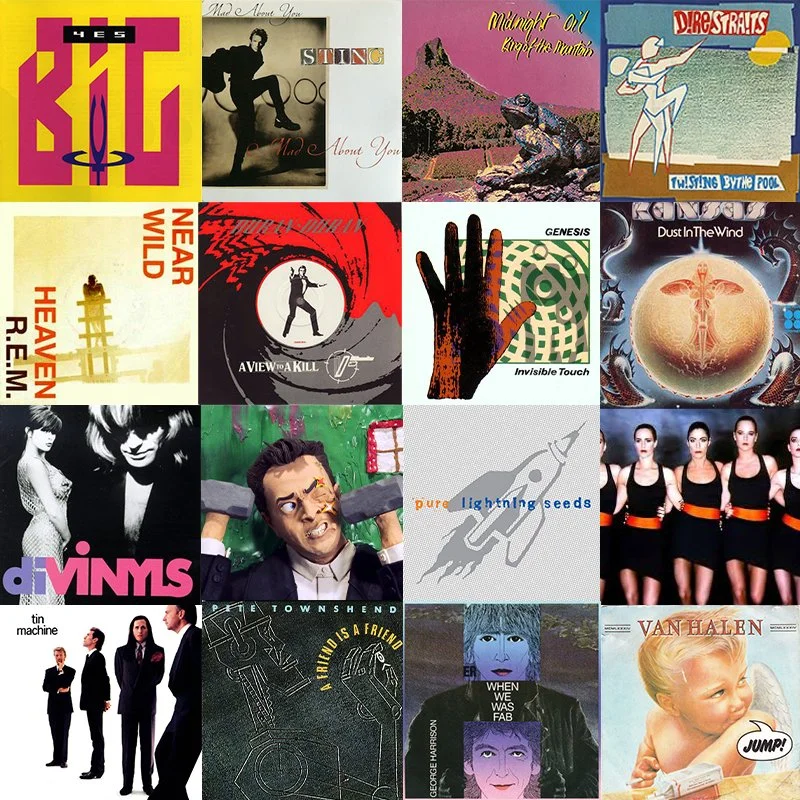
Side 1:
Love Will Find a Way – Yes
Truth Hits Everybody – The Police
Dust in the Wind – Kansas
All for Leyna – Billy Joel
Sledgehammer – Peter Gabriel
Even the Losers – Tom Petty and the Heartbreakers
Near Wild Heaven – R.E.M.
Anything She Does – Genesis*
Long, Long Way from Home – Foreigner
Annie Get Your Gun – Squeeze
Freewill – Rush
Squeeze Box – The Who
Sacrifice Yourself – Tin Machine
I Touch Myself –The Divinyls*
Side 2:
Simply Irresistible – Robert Palmer*
Mad About You – Sting*
King of the Mountain – Midnight Oil
Fortunate Son – Creedence Clearwater Revival
Twisting by the Pool – Dire Straits
Miracle Man – Elvis Costello
A View to a Kill – Duran Duran*
Pure – The Lightning Seeds*
United State – Hall and Oates
When We Was Fab – George Harrison*
Jump – Van Halen
When the Sky Comes Falling Down – The Pursuit of Happiness
Hold On – Lou Reed
A Friend Is a Friend – Pete Townshend
*Artist’s series debut
I was approaching the end of my first schoolyear in Montreal, nearing my 16th birthday, and I remained unmoored. I was ridiculously lonely, virtually begging other kids to hang out with me—I remember one Friday afternoon overhearing fellow students talking about planning to see a movie (Misery), and going to the theater early to buy a ticket before it sold out so I could “accidentally” run into them at the screening. My closest companion was my lovable orange cat, Jake, and I knew I was in a bad way when I literally got upset at him for leaving the room while I was talking to him. One night, I was so miserably bored, I considered breaking into my parents’ liquor cabinet and getting drunk.
The previous year, my parents had told me to say goodbye to my beloved summer camp—Buck’s Rock in New Milford, Connecticut, an arts-focused, free-form collective of privileged East Coast misfits—demanding I do something more enriching with the following summer. But toward the end of tenth grade, around the time I made Supermix 6, my parents sat me down and told me they’d decided (out of pity, I imagine) I could return to camp. It would be my fourth summer there (out of five total; I returned as a counselor in 1994), and it had become, more than anywhere else, my home, the first place I really felt I belonged (I still maintain some friendships from there). It also gave me a peek into a world that most people, even most well-off lefties like me, don’t discover until they get to college: artists, hipsters, homosexuals (still mostly in the closet in those days), and music snobs. It’s surprising it’s taken me till the sixth edition to mention this camp, because it deserves much of the credit for my early musical tastes. I’ll always remember Buck’s Rock fondly; even though I haven’t spent a summer there in more than 30 years, not a year goes by I don’t briefly wish I’d committed my July and August to returning.
Which is why revisiting Vol. 6, I’m surprised how few tracks are here that I think of as “Buck’s Rock artists.” (It’s the rare early volume without a song from They Might Be Giants, the brainy gods of the BR mindset.) There is a minor hit called “Pure” by a British electropop act called the Lightning Seeds, a song I bought on cassette single (“Haven’t thought of those in forever," you’re saying to yourself) after some older kids played it the summer earlier. There’s nothing particularly special about this tune, but I still like it—it’s arch, it’s transparently hip, it’s fun, and it’s overly emotional, which reminds me perfectly of those summers.
Otherwise, Vol 6 is fine, but not exceptional. Notwithstanding the Lightning Seeds, lots of resolutely un-hip artists here: Genesis, Robert Palmer, Billy Joel, Sting without the Police, Hall and Oates before their grand hipster reappreciation. And that damn Divinyls song that was everywhere at the time—good for a lot of snickering (and still an ironic karaoke favorite), yes, but it holds up pretty well (I recall enjoying that entire album, in fact). A few of the earlier mixes showed my slow progression toward classic punk and edgy new wave, my embrace of slightly more left-of-center sounds, but I seem to put tapping the breaks a bit here. That’s okay—I was a kid, and I liked what I liked, I wasn’t afraid to admit it.
So I guess that means I was being less self-conscious, and I guess that means things were getting better, somewhat. Were they? Sure, looking back 35 years, why not? And hey, it took me less than a year, how about that?