Supermix 9: Peace of Mind
Created late 1991
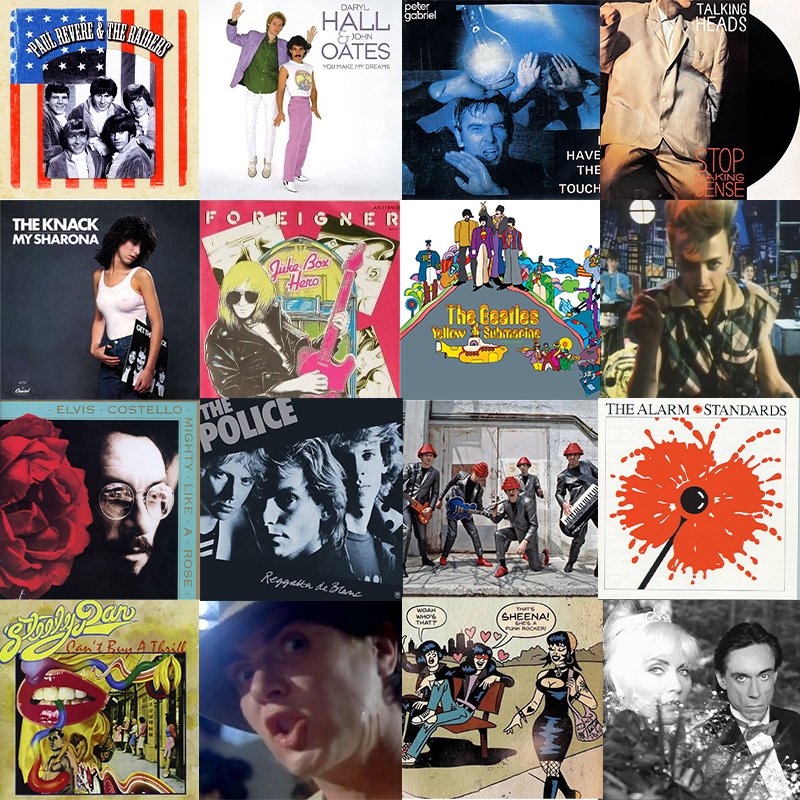
Side 1:
Once in a Lifetime (live) – Talking Heads
Reeling in the Years – Steely Dan*
Hungry Like the Wolf – Duran Duran
You Make My Dreams – Hall and Oates
Well Did You Evah – Debbie Harry and Iggy Pop*
The Waiting – Tom Petty and the Heartbreakers
No Time This Time – The Police
I Have the Touch – Peter Gabriel
Yellow Submarine – The Beatles
The Other Side of Summer – Elvis Costello
Sheena Is a Punk Rocker – The Ramones
Whistling in the Dark – They Might Be Giants
Peace of Mind – Boston
Side 2:
Shake Your Moneymaker – George Thorogood and the Destroyers*
Men in Helicopters – Adrian Belew†
Stray Cat Strut – The Stray Cats*
My Sharona – The Knack*
Badlands – Bruce Springsteen*
Gut Feeling – Devo
Ziggy Stardust – David Bowie
Texarkana – R.E.M.
In Praise of Sha Na Na – The Dead Milkmen
Rescue Me – The Alarm*
Kicks – Paul Revere and the Raiders*
Juke Box Hero – Foreigner
Won’t Get Fooled Again – The Who
*Artist’s series debut †Unavailable on Spotify
We’re in late 1991 at this point, my second year in Montreal, and I think it’s fair to say I’d gained some footing in Canada. (I look back on my three years there as being split into two roughly even halves: Eighteen months of utter discomfort, followed by a year and a half of a pretty great high school experience, all things considered.)
I’d had a miserable experience with Into the Woods in 1990/91 and vowed to not return to the synagogue for the next year’s teen production: I made a promise to myself to turn my back on people who didn’t appreciate me (in hindsight, it wasn’t just me; those kids in the Into the Woods cast really were pretentious). But I was seduced into breaking my promise by the production team’s selection of my all-time favorite stage musical: Little Shop of Horrors. So I went into auditions focused: I would engage the other kids only as it suited me, and I would make a conscious play for what I then considered my dream role—the sadistic dentist, made famous by Steve Martin in the fantastic movie adaptation—quitting the show if I was cast as anything else. I thus auditioned by reading a comically violent poem I found in a Buck’s Rock yearbook, and was pleasantly surprised to discover a mostly new group of kids, not to mention a new production team. And something clicked: This year’s director (Kim Hardt, a wonderful woman I’ll never forget) recognized my talent, having me read/sing at the callback not only for both the Dentist, but also for the show’s lead role, Seymour Krelborn. Could I really be the show’s hero?, I wondered. A year earlier that would seem improbable, but it seemed tantalizingly possible. (It helped that I’d made it through the bulk of puberty by this point.)
So it was then a shock when, at the first rehearsal, I was told I’d been cast as Mr. Mushnick, the crotchety, antagonistic old shop owner, a solid supporting role (with his own spotlight song, omitted from the film). It was a possibility that had never occurred to me, and Kim, sensing my surprise, took me aside to tell me something to the effect of, “Nobody who auditioned jumped out at us appropriate for Mushnick, but we were so impressed with you, we figured you could handle any challenge.” That was probably the greatest compliment I’d received to that point in my life, and I savored it—especially when the entire Little Shop experience turned out to be a whole mess of fun, bringing me new friends and new confidence. (The mid-20s choreographer later told me she was surprised I was 16—she thought I’d been a college student. That might literally have been the first time someone thought I was older than I was.)
All told, my second year in Montreal was a massive improvement over my first. Of course, I still wanted more than anything to make a romantic connection, and going to an all-boys school, there were precious few opportunities. When I did find myself with an chance, I was still very poor at taking advantage, though I did manage my second kiss at a fall school dance—once again, however, there was no follow-up to speak of, and I don’t even recall the girl’s last name. Sometime around early spring, I got around to making Supermix 9, and perhaps being preoccupied by actually enjoying my life, I created what I now (and basically then) consider the first “bad” mix in the series.
How is it bad, exactly? I mean, why would I have ever made a mix full of songs I didn’t like? I didn’t, of course: At the time I approved of all these songs, and revisiting it today, some of these songs easily belong in my A-tier (“Reeling in the Years” and “Ziggy Stardust” are my favorite Steely Dan and Bowie songs respectively, “Won’t Get Fooled Again” belongs on any Noah-approved list of the greatest songs of all time, and “My Sharona” will never not be a stone-cold classic). But a few of these choices, while not regrettable, are no longer what I’d consider Supermix-worthy. For years I regarded “Shake Your Money Maker” by George Thorogood as the worst song to ever appear on one of my mixes; a different song of his had caught my ear at camp, I borrowed the CD from that rental place, and for whatever reason put this tune on Vol. 9, almost immediately regretting it. But my opinion has softened upon a relisten, and damn, that guy can play guitar.
Some other less-than-stellar selections: “In Praise of Sha Na Na” is not the Dead Milkmen at their most clever; “Texarkana” is the rare R.E.M. song sung by bassist Mike Mills; the Alarm now sounds to me like cut-rate U2; and I’ve never really warmed up to the Talking Heads, despite my best intentions. Plus, very little here snaps for me, transition-wise. Still, for whatever reason, I quickly tired of Vol. 9 and revisit it much more seldom than other early series entries. I suppose it’s encouraging that Supermixes had reached the status of sex and pizza: Even when they’re bad, they’re still pretty good.