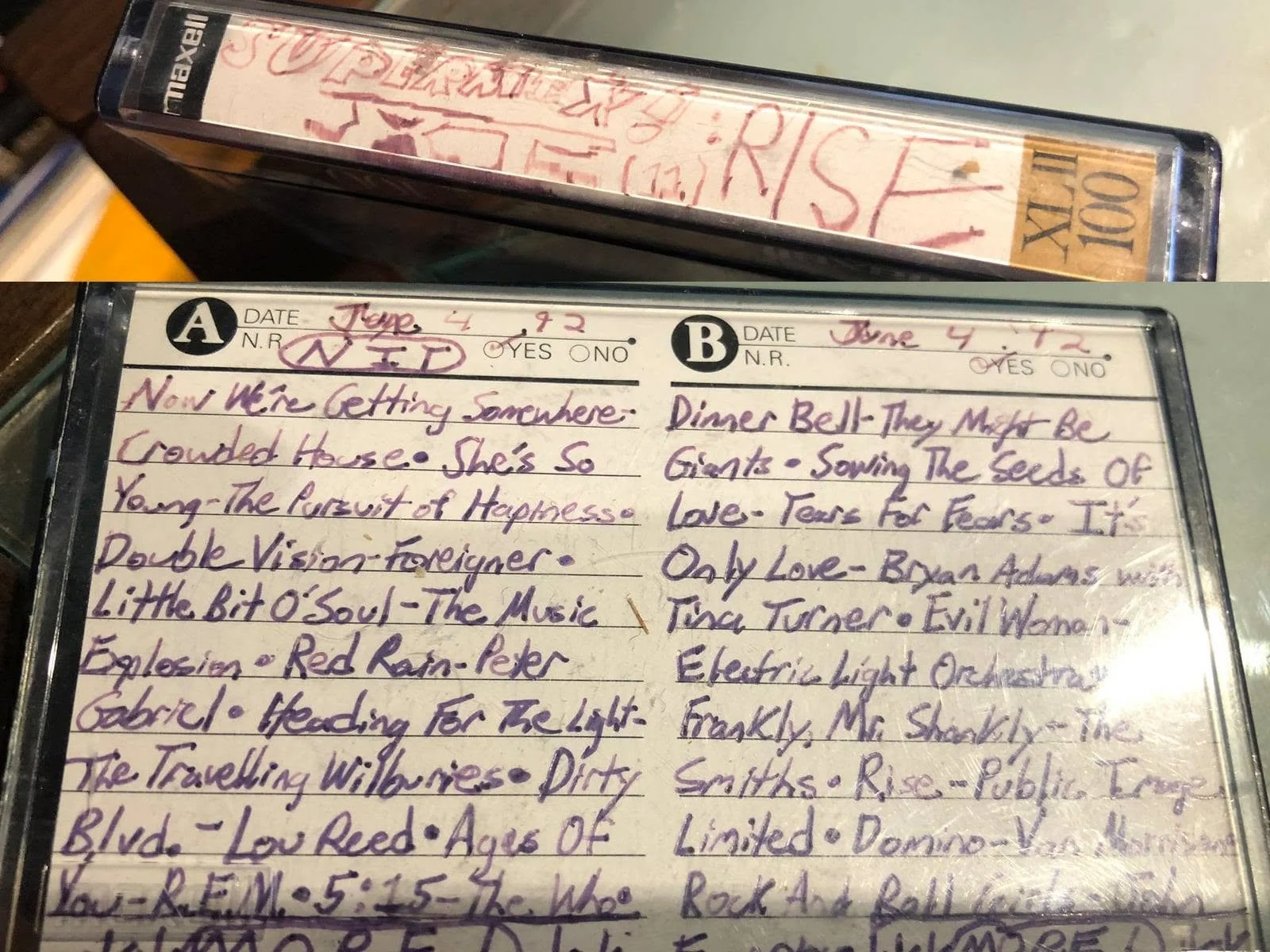
listen to and read about the dozens of mixtapes i’ve made since 1990
In late 1988, shortly after I turned 13, I discovered rock & roll. Yes, of course, rock & roll was at that time more than 30 years old, and as an American child fully exposed to mainstream culture (I was neither home-schooled nor Amish), I was familiar with the rock art form. But I’d never paid very much attention to it—music was merely the ocean in which I paddled my ineffectual young boat, rock & roll being a major constituent in that sea water. I liked guitars, 4/4 rhythms, and loud, musically flamboyant young men (I maintained a modest cassette tape collection, I’d seen Daryl Hall and John Oates in concert, and a Duran Duran poster had once graced my bedroom wall), but rock—really, music in general—was in no way my passion.
And then, as a good Jewish boy, I was bar mitzvahed. And as a newly minted Jewish adult, I felt the mental beckoning of my teenage years, realizing I’d have to develop some non-juvenile interests if I wanted to compete in the world of adolescence, loudly beckoning with high school less than a year away. I looked at who I was, and I did not see the potential for teenage success. In addition to still being two years from a growth spurt, my interests were limited, and decidedly immature: I never liked sports, video games left me cold, I wasn’t confident enough to be a skateboarder, and the one respectable thing that naturally appealed to me—theater—was essentially unavailable to me for reasons I can’t get into now. (Those of you who know me and want to say, “What about comic books and pro wrestling?” can sit down, thank you very much.) So inspired by two of my mitzvah gifts—a Sony Discman (the vanguard of the recorded-music experience at the time) and a generous gift certificate to Sam Goody’s (the preeminent music-media chain in my northern New Jersey region)—I very consciously endeavored to become a Rock & Roll Guy.
Thus, I used that certificate to form the nucleus of an obsessively curated compact-disc collection, and I switched my bedroom-radio dial from Z100 to WNEW, trading the dreadful Top 40 schlock of the late ‘80s for the by-that-time wholly consecrated classic-rock pantheon, e.g., the Beatles, the Rolling Stones, the Who, et al. At the time, it all seemed so venerable, so time-tested, even though “classic rock” was then less than 20 years old. But I was still young, the world was still new, and the thrill of discovery was still nearly constant.
It didn’t feel forced at all; rock & roll truly spoke to me—its energy, its fury, its frisson of rebellion kept at a safe distance via the magic of recorded sound. Identity had always been a slippery concept for me, and rock & roll—larger than life, masculine as hell, and cool as shit—pointed to a satisfying, comforting way forward for a young man who’d never quite fit in where he was supposed to.
Cut to a bit more than a year later, and I considered myself a verifiable budding rock snob. And, as someone who’d always had the mind of a collector and cataloger, it was only natural I adopt a hobby common to music geeks of the era: I decided to make a mixtape. I’d purchase a Maxell blank cassette and compile some of my favorite tracks from that mushrooming CD collection into one perfect, 90-minute précis of Noah Tarnow’s musical identity.
Thus was born the very first Supermix. And I listened to the hell out of that thing, over and over again—on my Walkman as I walked home from school, via my parents’ car tape deck when I could convince them, and even on my bedroom boombox as I slept. And a few months later, deciding more of a good thing is a great thing when it comes to the music I love, I made Supermix Vol. 2, followed soon after by Vol. 3., then Vol. 4, then 5, and onward and onward, to today. A total of 106 volumes as of this writing, and I’ve never repeated a song.
Several years into the project, bored while home from college, the trainspotting collector in me emerged and began cataloging the series, making sure each lineup wouldn’t fade into the mists of time were I to ever misplace the cassettes themselves. I even began analyzing the project statistically, determining how many total songs have appeared, how many total artists, which artists have appeared the most, and various other details of the most picayune sort. (Another great thing about becoming a Rock & Roll Guy: I didn’t have to stop being a nerd.)
And I’ve hardly shared this with anyone, until now. What does it all mean? Arguably nothing, but I do view the series as a diary, the story of my life in the form of nit-picking musical fandom. There is no more potent tool than an older Supermix to take me back to a certain time and place in my life: A specific school cohort, an out-of-town trip, a romantic obsession. And yes, it’s rare that a week goes by without me relistening to an older volume; I maintain the lineups for all in my Apple Music collection, progressively on Spotify, and in physical media when applicable.
Since we’re now up to 106 volumes, and I’m up to more than five decades of life, I can’t count on my uncanny memory forever. Plus, being who I am, I see no reason not to share what I consider a lifetime achievement with the world. So here it is, for whatever that’s worth: The Supermix Project. Here I’m progressivly listing every entry in the 36-plus-year series. You can see each lineup, listen to each playlist, and—over time— read my thoughts and memories about each mix’s creation (as best I remember; I didn’t note the exact months and years of creation until I was a ways into the project). And If you’re really of the music-collector’s mental bent, stay tuned as I post statistics pertaining to the series as a whole. Read, listen, enjoy, and discover the music I love and the person I’ve been.